
TempleOS Editorial · Donation Management
80G Donation Receipts: Simple, Fast & Hassle-Free
Generate donation receipts quickly, keep donor records organised and provide documentation to support eligible tax-deduction claims.

How Automated 80G Donation Receipts Help Temple Trusts
Managing donations is an important responsibility for every temple trust. Along with receiving contributions, trusts need to maintain accurate donor information, generate proper receipts, organize donation records, and provide donors with the necessary documentation.
An automated 80G donation receipt system can simplify these processes by reducing manual work and making receipt generation faster, more accurate, and convenient for both temple staff and donors.
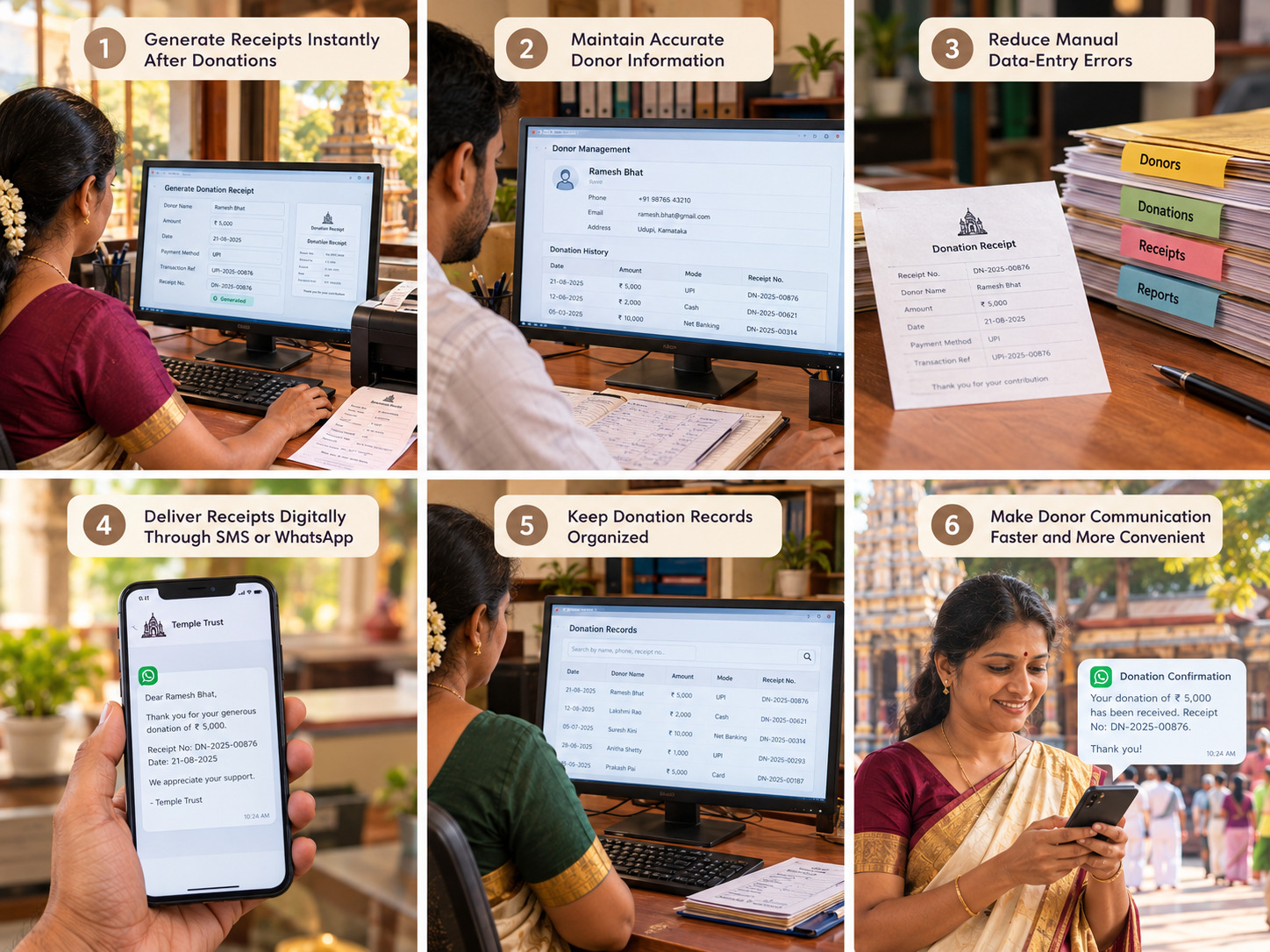
1. Generate Receipts Instantly After Donations
When a donation is received, generating a receipt manually can take additional time, especially when the trust handles a large number of donations every day.
An automated system can generate the donation receipt as soon as the transaction is recorded. Important details such as the donor's name, donation amount, date, payment details, and other required information can be captured systematically.
This helps temple offices:
- Generate receipts quickly
- Reduce waiting time for donors
- Avoid repetitive manual preparation
- Handle large volumes of donations efficiently
- Provide donors with timely documentation
Instant receipt generation also creates a smoother donation experience and allows staff to focus on other administrative activities.
2. Maintain Accurate Donor Information
Maintaining correct donor information is essential for effective donation management. Manual entry can sometimes result in spelling mistakes, duplicate records, missing information, or incorrect contact details.
An automated donation system can maintain centralized donor records and associate each donation with the relevant donor information.
Depending on the system's configuration, trusts can maintain details such as:
- Donor name
- Contact information
- Address
- Donation amount
- Donation date
- Payment method
- Transaction/reference details
- Receipt information
Having organized donor data makes it easier for temple offices to retrieve previous donation details and maintain consistent records.
3. Reduce Manual Data-Entry Errors
Manual data entry can become challenging when staff members have to enter the same information across multiple registers, spreadsheets, and receipt formats.
Automating the receipt process can reduce repetitive data entry and minimize common errors such as:
- Incorrect donor names
- Wrong donation amounts
- Duplicate entries
- Incorrect receipt numbers
- Missing transaction details
- Inconsistent donor records
When donation information is captured systematically, the trust can maintain more reliable records and reduce the need for repeated corrections.
4. Deliver Receipts Digitally Through SMS or WhatsApp
Today's donors often prefer receiving important documents digitally rather than collecting or storing physical copies.
An automated donation system can enable digital receipt delivery through supported communication channels such as SMS or WhatsApp, depending on the system's integrations and configuration.
After a donation is recorded, the receipt can be shared with the donor digitally, helping them access their donation documentation conveniently.
Digital delivery can provide several benefits:
- Faster receipt communication
- Reduced dependence on printed receipts
- Convenient access for donors
- Less administrative work for temple staff
- Better communication with donors
It can also be particularly useful for donors who contribute remotely or make donations through online payment channels.
5. Keep Donation Records Organized
For temple trusts, maintaining organized donation records is important for day-to-day administration, reporting, and record-keeping.
An automated system can bring donation information into a centralized platform instead of relying entirely on multiple physical registers or spreadsheets.
Trust administrators can use organized records to search and review donation information based on relevant criteria, depending on the features available in the software.
This can make it easier to:
- Track donations
- Search donor records
- Review receipt history
- Prepare reports
- Monitor donation activity
- Maintain systematic documentation
A centralized approach can also make routine administrative tasks more efficient.
6. Make Donor Communication Faster and More Convenient
Donor communication is an important part of maintaining a positive relationship between a temple trust and its devotees.
When receipts and donation-related communications are automated, donors can receive important information more quickly without requiring staff to manually contact each person.
For example, after a successful donation, the system can support automated communication such as receipt delivery or donation confirmation, subject to the available integrations.
This helps create a more convenient experience for donors while reducing repetitive communication tasks for temple staff.
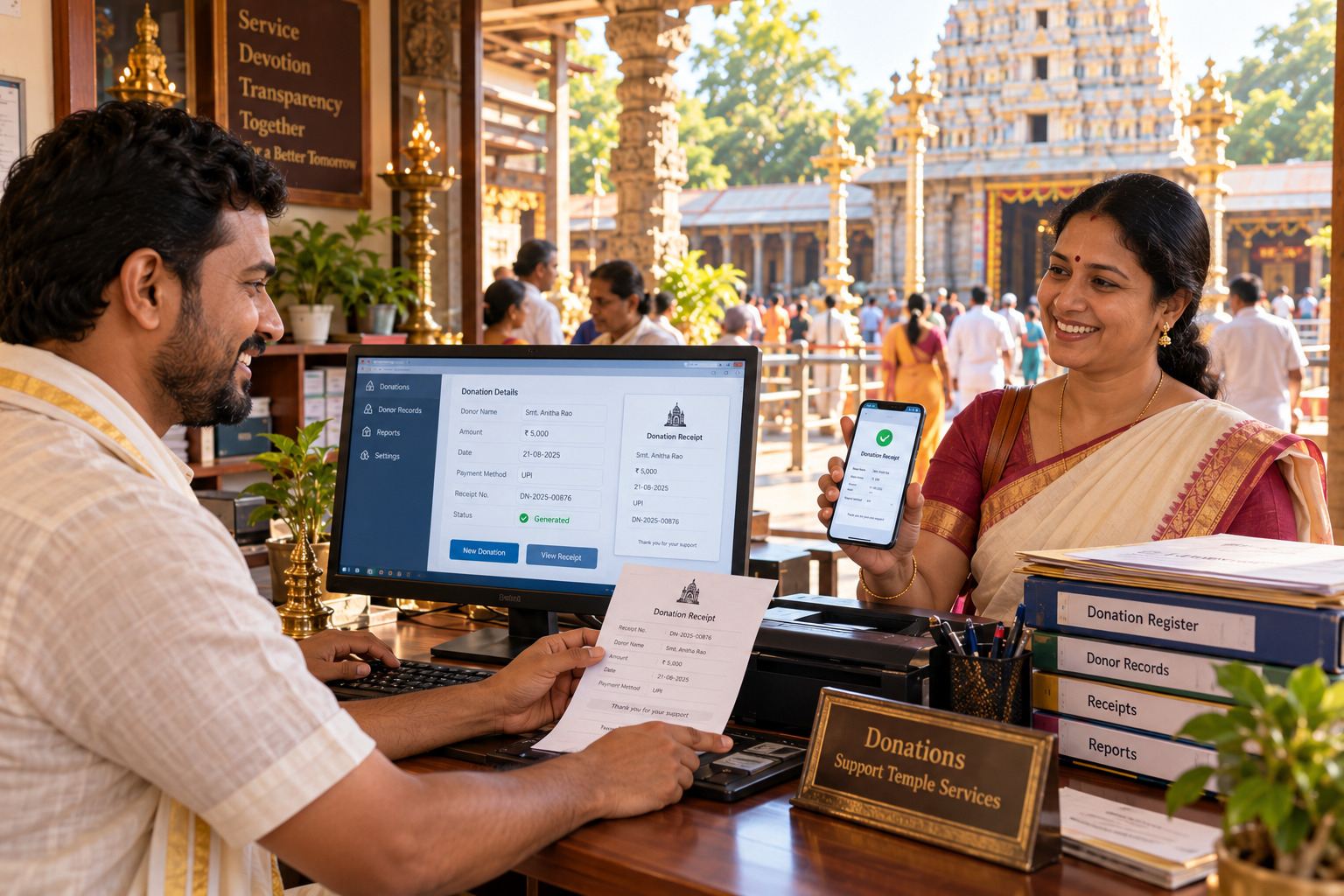
Improving Transparency and Efficiency
A streamlined donation and receipt-management process can help temple trusts maintain clearer and more organized financial documentation.
Automating routine processes such as receipt generation, donor-record management, and digital receipt delivery can reduce administrative workload and provide staff with more time for other important temple activities.
At the same time, maintaining structured records can support better internal tracking and easier retrieval of donation information when required.
A Smarter Approach to 80G Donation Receipt Management
For temple trusts handling a growing number of donations, moving from manual receipt management to an automated system can simplify everyday operations.
From instant receipt generation and accurate donor records to digital delivery through SMS or WhatsApp, automation can make the entire donation-receipt process more efficient.
A well-designed 80G donation receipt management system can help temple trusts improve administrative efficiency, maintain organized records, and provide donors with a faster and more convenient receipt experience.
Conclusion
Managing donations should not be a time-consuming administrative process. By adopting automated receipt generation and digital communication, temple trusts can simplify their workflows while maintaining organized donor and donation records.